Working in another country can open the door to better career opportunities, international experience, and professional growth. However, before starting a job abroad, employees may need to complete several document verification and legalization formalities.
One of the most important processes is Certificate Attestation.
Certificate Attestation is the process of verifying and authenticating documents so they can be accepted by authorities, employers, immigration departments, universities, or other organizations in a foreign country. Depending on the destination country and type of document, the process may involve state-level authentication, Ministry of External Affairs (MEA) attestation or apostille, and embassy or consular legalization.
What Is Certificate Attestation?
Certificate Attestation is the authentication of an Indian-issued document for use outside India.
For overseas employment, documents such as educational certificates, degree certificates, diplomas, experience certificates, and certain personal documents may need to be authenticated before they are accepted by the relevant foreign authority.
The Ministry of External Affairs states that it attests original documents or true copies for use abroad. India uses both Apostille and Normal Attestation, depending on the destination country’s requirements.
Why Is Certificate Attestation Required for Overseas Employment?
- To Verify the Authenticity of Your Qualifications
Foreign employers and authorities need confidence that the educational and professional documents submitted by an applicant are genuine.
For example, if you are applying for a job overseas using a bachelor’s degree, master’s degree, diploma, or professional qualification, the receiving country may require the document to be authenticated before accepting it.
Attestation helps establish the authenticity and origin of the document.
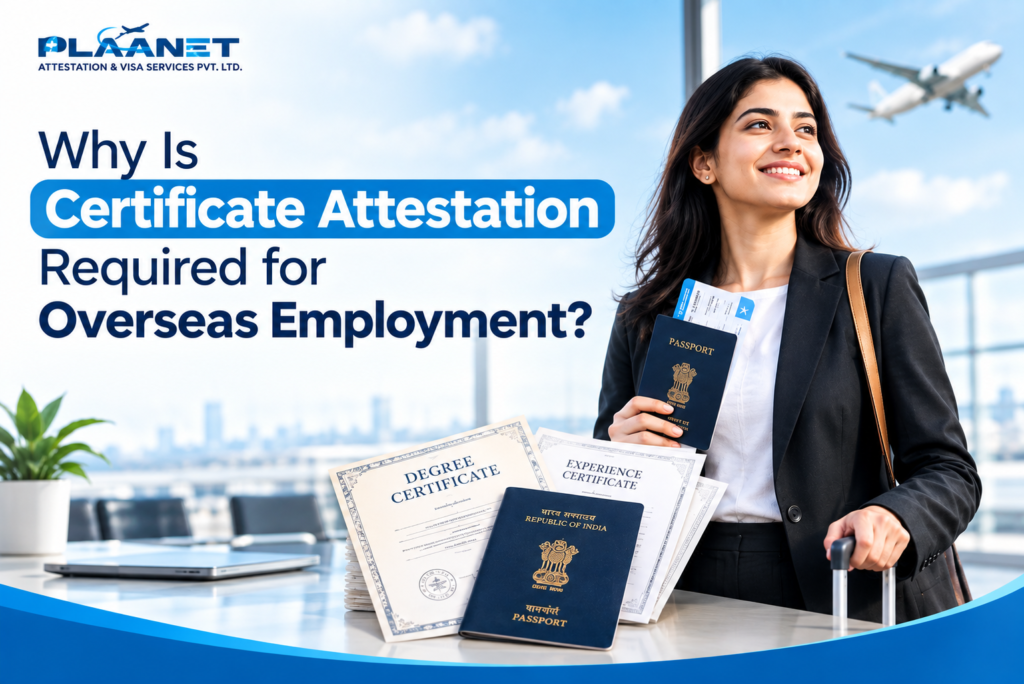
Why Is Certificate Attestation Required for Overseas Employment?
Working in another country can open the door to better career opportunities, international experience, and professional growth. However, before starting a job abroad, employees may need to complete several document verification and legalization formalities.
One of the most important processes is Certificate Attestation.
Certificate Attestation is the process of verifying and authenticating documents so they can be accepted by authorities, employers, immigration departments, universities, or other organizations in a foreign country. Depending on the destination country and type of document, the process may involve state-level authentication, Ministry of External Affairs (MEA) attestation or apostille, and embassy or consular legalization.
What Is Certificate Attestation?
Certificate Attestation is the authentication of an Indian-issued document for use outside India.
For overseas employment, documents such as educational certificates, degree certificates, diplomas, experience certificates, and certain personal documents may need to be authenticated before they are accepted by the relevant foreign authority.
The Ministry of External Affairs states that it attests original documents or true copies for use abroad. India uses both Apostille and Normal Attestation, depending on the destination country’s requirements.
Why Is Certificate Attestation Required for Overseas Employment?
- To Verify the Authenticity of Your Qualifications
Foreign employers and authorities need confidence that the educational and professional documents submitted by an applicant are genuine.
For example, if you are applying for a job overseas using a bachelor’s degree, master’s degree, diploma, or professional qualification, the receiving country may require the document to be authenticated before accepting it.
Attestation helps establish the authenticity and origin of the document.
- To Meet Immigration and Visa Requirements
In some countries, authenticated documents may be required as part of employment visa or work-permit procedures.
The exact requirements vary according to the destination country, profession, visa category, and local regulations. Therefore, applicants should always confirm the document requirements with the employer, embassy, immigration authority, or other relevant authority.
- To Help Foreign Authorities Recognize Indian Documents
A certificate issued in India may not automatically have the same legal recognition in another country.
Authentication or legalization provides a formal mechanism for the receiving country to recognize the origin of the document.
For countries covered by the Hague Apostille Convention, an apostille may be used where applicable. For countries where apostille is not accepted, normal attestation/legalization procedures may apply.
- To Complete Employer or Professional Verification
Employers may request verified educational or professional documents before finalizing an overseas appointment.
Depending on the job, you may be asked to provide:
- Degree certificate
- Diploma certificate
- Mark sheets or transcripts
- Experience certificate
- Professional qualification certificates
- Training certificates
- Other employment-related documents
The exact list depends on the employer and destination country’s requirements.
- To Avoid Delays in the Employment Process
Submitting documents that do not meet the required authentication format can lead to additional verification, requests for corrected documents, or delays.
Getting the required authentication done before submitting documents to the relevant authority can help make the process more organized.
Which Certificates May Need Attestation for Overseas Employment?
The requirements vary by country and employer, but commonly requested documents can include:
Educational Documents
- Degree certificates
- Diploma certificates
- Mark sheets
- Academic transcripts
- Secondary and higher-secondary certificates
- Professional qualification certificates
Employment Documents
- Experience certificates
- Employment certificates
- Offer or appointment-related documents, where applicable
Personal Documents
Depending on the visa or employment situation, authorities may also request:
- Birth certificate
- Marriage certificate
- Police clearance-related documents
- Other personal certificates
The Ministry of External Affairs notes that educational documents such as degrees and diplomas can be apostilled, while personal documents such as birth and marriage certificates can also be subject to apostille procedures where applicable.
Certificate Attestation vs Apostille: What’s the Difference?
Certificate Attestation and Apostille are related but are not always the same process.
Apostille is used for documents intended for use between countries that participate in the Hague Apostille Convention, when an apostille is required.
Normal Attestation is used for countries where apostille is not accepted and the applicable legalization process requires attestation.
Therefore, you should identify the destination country and intended use of the document before choosing the appropriate procedure.
General Certificate Attestation Process in India
The exact process depends on the document and destination country. A typical process may include:
Step 1: Document Verification
The document may first need authentication by the appropriate issuing authority or state-level department.
For educational documents, the relevant education authority may be involved. Personal documents can require authentication by the appropriate state authority.
Step 2: MEA Attestation or Apostille
After the required preliminary authentication, the document may be submitted for MEA attestation or apostille, depending on the destination country.
The MEA explains that documents not covered by e-Sanad generally go through authentication followed by submission through designated service providers.
Step 3: Embassy or Consular Legalization
For certain destinations, additional embassy or consular legalization may be required after MEA authentication.
Because requirements differ between countries, applicants should verify the current procedure for their specific destination.
Step 4: Submission to the Employer or Relevant Authority
Once the required authentication is complete, the documents can be submitted to the employer, immigration authority, embassy, licensing body, or other organization requesting them.
Can Certificate Attestation Be Done Online?
Some documents may be eligible for online verification and attestation through e-Sanad, an initiative of the Ministry of External Affairs.
According to the official e-Sanad platform, the service is designed to provide online verification and attestation/apostille for eligible documents available in digital repositories.
However, not every document follows the same process, so applicants should check whether their particular certificate is eligible.
Common Mistakes to Avoid
When preparing documents for overseas employment, avoid these common mistakes:
- Choosing the wrong authentication process
Apostille and normal attestation are not interchangeable in every situation. - Ignoring destination-country requirements
Different countries may have different legalization procedures. - Submitting incomplete documents
Missing certificates, copies, identification documents, or preliminary authentication can cause delays. - Waiting until the last minute
Document authentication can involve multiple stages, so starting early is advisable. - Relying on outdated information
Embassy and immigration requirements can change. Always confirm current requirements before submitting documents.
Why Choose Professional Certificate Attestation Assistance?
The Certificate Attestation process can involve multiple authorities and requirements. A professional attestation service can help applicants understand the required steps, prepare documents, coordinate submissions, and track the process.
If you are planning to work abroad and need assistance with document authentication, Plaanet Attestation & Visa Services provides document attestation and legalization-related assistance for various international destinations.
You can learn more about their services at https://plaanetattestation.com/.
Final Thoughts
Certificate Attestation is an important part of preparing Indian documents for use abroad. For overseas employment, authenticated documents can help employers and foreign authorities verify the origin and authenticity of your qualifications and other required certificates.
The exact procedure depends on the destination country, document type, employer requirements, and applicable immigration or legalization rules. Before beginning the process, make sure you confirm the latest requirements with the relevant foreign authority or employer.
If you need assistance with document attestation, apostille, or legalization for overseas employment, visit Plaanet Attestation & Visa Services at https://plaanetattestation.com/ and explore the services available for your destination country.